Hurricane season in Emerald Isle
Most hurricane-season trips go off without a hitch. Here is when the risk is real, what has hit the Crystal Coast before, and how to protect your trip.
Tropical outlook right now
National Hurricane Center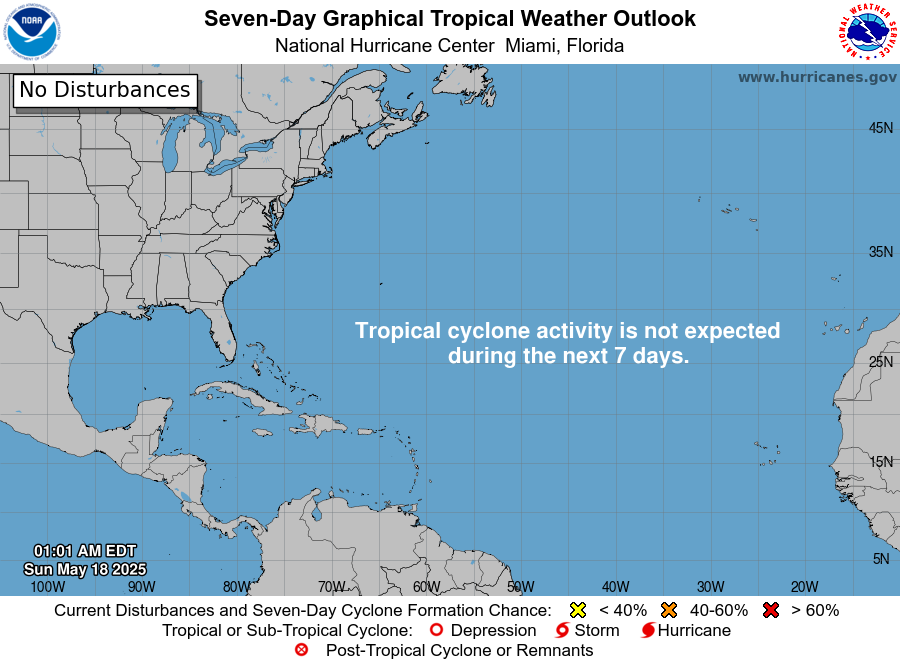
Updated by the National Hurricane Center every six hours during the season. Active NWS alerts for Emerald Isle show at the top of every page on this site.
When the risk is real
The season officially runs June 1 to November 30, but for the Crystal Coast the meaningful window is mid-August to mid-October, with September as the peak. June, July and November storms happen but are uncommon here.
On a barrier island the biggest dangers are often water, not wind: storm surge on the ocean side, wind-driven flooding on the sound side, and rainfall flooding on the mainland roads you need to leave. The two bridges off Bogue Banks, the Emerald Isle bridge to Cape Carteret and the Atlantic Beach causeway to Morehead City, are the only ways off the island by car.
Storms that hit the Crystal Coast
- Florence (2018). Made landfall as a Category 1 hurricane at Wrightsville Beach after stalling offshore. Days of wind and record rainfall flooded much of eastern North Carolina.
- Dorian (2019). Made landfall at Cape Hatteras as a Category 1 hurricane after brushing the Crystal Coast with tropical-storm conditions.
- Arthur (2014). Made landfall on Shackleford Banks near Beaufort as a Category 2 hurricane on July 3, just east of Bogue Banks, an early-season reminder.
- Irene (2011). Made landfall near Cape Lookout as a Category 1 hurricane, with storm surge and sound-side flooding along the Crystal Coast.
- Ophelia (2005). Crawled up the coast with its center just offshore, bringing hurricane-force gusts, beach erosion and sound-side flooding to Carteret County.
- Isabel (2003). Made landfall on the Core Banks as a Category 2 hurricane, northeast of the Crystal Coast.
- Bertha and Fran (1996). Two hurricanes in one summer made landfall in southeastern North Carolina, Bertha in July and Fran as a Category 3 in September.
Your rental and NC law
North Carolina’s Vacation Rental Act protects renters. If state or local officials order a mandatory evacuation covering your rental, you have to leave, and you are entitled to a refund of rent, taxes and fees, prorated for each night you can’t stay. The catch: no refund if, before check-in, you either declined or bought the evacuation insurance the landlord or broker offered. Read G.S. 42A-36.
A simple plan
- Book with flexibility from August through October, and read the rental’s evacuation and insurance terms.
- Watch the National Hurricane Center outlook in the week before you go.
- Follow Carteret County Emergency Services and the Town of Emerald Isle for evacuation orders.
- If an order comes, leave early. Bridge traffic builds fast.
Questions people ask
When is hurricane season in Emerald Isle?
June 1 through November 30. The real risk for the Crystal Coast is concentrated from mid-August through mid-October, and the Atlantic season peaks around September 10.
Do I get a refund if my rental is evacuated?
Under North Carolina’s Vacation Rental Act (G.S. 42A-36), if state or local officials order a mandatory evacuation that covers your rental, you must leave and you are entitled to a prorated refund for the nights you lose. The exception: no refund if you turned down, or bought, the evacuation insurance the landlord or broker offered.
Should I buy travel insurance for a fall trip?
It is worth considering from August through October. Standard policies usually pay only for covered events like a mandatory evacuation. Cancel-for-any-reason coverage costs more but lets you back out when a storm is only threatening.
What is a nor’easter?
A strong coastal storm with northeast winds, most common from fall through spring. Nor’easters hit the island more often than hurricanes and can bring days of wind, high surf, beach erosion and sound-side flooding.